She Had 20 Minutes to Cry.
A case for the end of private grief: moving from “getting over it” to witnessing each other in the wreckage.

B Gabriella Brown • Apr 14, 2026 • on Substack
A quick note: This piece dives into grief, including mentions of sudden and traumatic death. Please check in with yourself before reading. If you’re currently underwater, it’s okay to save this for a day when you’re closer to the surface.
I refer to the summer of 2018 as “The Summer Everyone Died.”
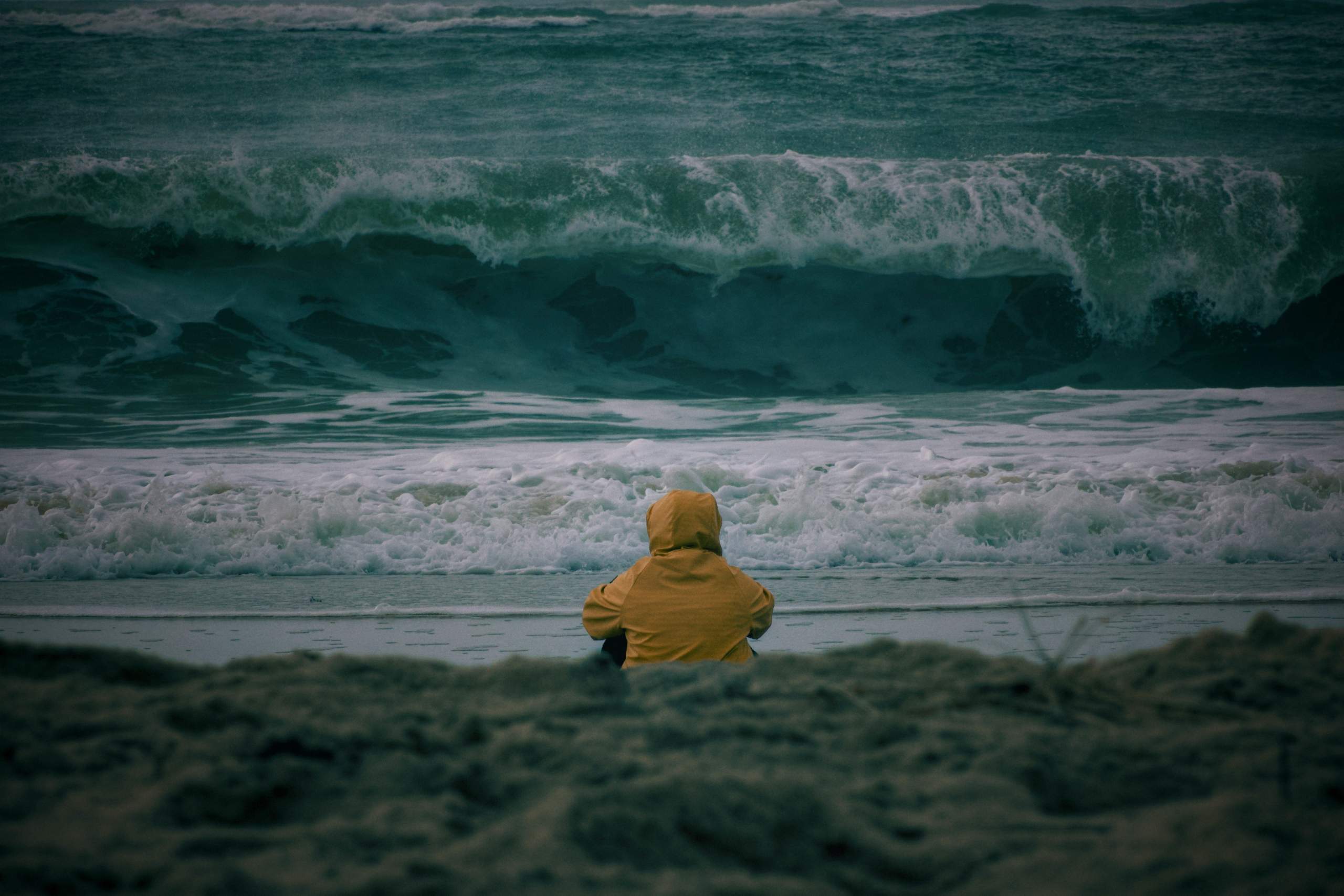
When I think about that summer, I picture the ocean. The Rockaways, maybe, even though I didn’t take the A train trek once that summer. But I see myself, my community, our little corner of Manhattan, just tossed in the mid-morning surf.
When grief hits more than once, it doesn’t wait for you to dry off. The first wave knocks you down. The second one fills your mouth with salt. The third takes your feet out from under you before you can even find which way is up.
That summer was 8 weeks of tragedy. People who were woven into my life, people that I would see at the neighborhood pub, or at the corner store buying a bacon egg and cheese in the morning, or at our all-hands work meetings, or in my text messages sharing a song we both loved…. suddenly, gone. All at once, there was empty space where they once stood. Yellow tape at the door to their apartment buildings. A text left unread.
Cancer. Overdose. Hit and run. Old age. A horrible accident, a fall from a fire escape as teenagers hung out at a party. And death by suicide.
No one knew how to handle my grief. Not even me.
So I did the thing I do best, when trying to deal with my own depth of feelings. I decided to help others with theirs. As a therapist, I don’t actually recommend trying to save others from their emotions as a coping mechanism to avoid your own.
But when I sat in my own therapist’s office that summer, somewhere between the second and fourth news of death, tears streaming down my face, she handed me a crystal for good luck and told me she didn’t “work with grief,” that universal human emotion, and that I should find someone else;
and when one of my best friends sat beside me at the group support that my workplace provided, just to say “you’re not okay, and I don’t know how to help you,” desperately, well-intentioned, but in a way that made the walls close in on that basement office;
and when my (now-ex) partner told me, one night as he wandered out of bed to find me on the patio at 3am, staring into the darkness, “I don’t know why you’re not over this yet…”;
I heard over, and over, and over again: I don’t know how to be with this.
Grief makes people look for an exit. My therapist had a professional one. My friend had a well-meaning one. My partner had an impatient one. But they were all leaving the room. They didn’t know how to stay.
In the US, we don’t know how to be with each other in grief because we were never taught it. Our relational defaults were built for productivity, for moving on, for not burdening others. We inherited scripts that treat grief like a problem to be solved on a timeline, and when it refuses to move along on that schedule, we reach for the exits, and sometimes the impatient suggestion that someone should be “over it” by now.
We live in an extraordinarily individualistic moment in the US. What I see in Mexico, by contrast, is a community structure, religious and spiritual networks, and multi-generational households that hold grief collectively. A whole season of connecting to our ancestors who have died. Visiting cemeteries to leave them their favorite food on their graves, telling stories, printing old photos. My family sitting around a table last year, trying to remember who was whose son or father or husband, when there were four Rafaels and two Rafaelas pictured somewhere on the mantel, but determined to name each of them, to honor each of them.
In the US, that type of collective support has largely dissolved. What replaced it? Therapy, (which is private, boundaried, and can also fail, as my own therapist showed me). Self-help. A social media performance of resilience. One memorial post to the grid. A hundred likes. And then nothing. None of these are designed to let you grieve out loud, with witnesses, over time. You’re supposed to manage it alone, in private, efficiently.
And then I came across an organization in New Jersey, Good Grief. They were looking for “in community” program volunteers at the exact moment that I needed community and direction. We took groups of kids, gathered by age, and a group for their caregivers. The website cheekily declares “we put the Good in Grief.”
The little ones had colorful balls and crayons and picture books. The older ones had sketchpads and craft supplies and journals. The adults had each other, two hours of not thinking about childcare, and a lot of prayer, to whichever heaven they needed.
That summer, I learned that showing up for each other was a survival skill. It was something I learned with my whole body, sitting criss-cross-applesauce on an empty gym floor, as I watched a seven-year-old read a page of “The Invisible String” to the group.
“Even though you can’t see it with your eyes, you can feel it with your heart, and know that you are always connected to everyone you love.”
We spent 6 weeks teaching kids the names of emotions. How to advocate for themselves, how to share with others how they were feeling. We helped kids see themselves, reflected in the experience of others. We played games, ate pizza, and passed each other napkins when the mess was all over our faces. We helped kids tell a story about the new, stranger versions of themselves that were left behind after the funeral.
I was learning a new version of myself, too.
But I did not have it together that summer. Most of the time.
I would leave my own therapy sessions, or my friend’s apartment, where he grieved the loss of his daughter, and my eyes would be swollen, watery, hidden behind sunglasses as I wandered the streets, trying to find a pocket of air to breathe between the waves.
One time after therapy I found myself in a cheese shop, had them wrap up $100 worth of cheese as I sobbed and pointed through the glass case, and sat on a streetside bench just gnawing on a chunk of gruyere. It was… messy. I had no idea what I was doing. Cheese felt like the closest thing to an anchor, that day.
But I got to climb onto dry land via NJ Transit, and show up for these kids, week after week. It was the only thing that made sense, when nothing else did. At this point, I had spent nearly a decade working with kids at the community center, I was a veteran of the elementary-school circus. I knew how to be the adult in a room of 2nd graders. I was good at holding space for a kid having big feelings.
But one week, a facilitator was out sick, and I was called in to help with the parent group. My heart was racing. Now I was expected to be a real expert, I thought, a compass in a room of other grieving adults, when I had spent most of that summer spinning without direction, with no earthly idea how I was going to move forward myself.
I can see vividly the circle of plastic chairs. A mom was sharing how she didn’t have time, taking care of three kids, to let herself cry. Before the “in community” program, she would schedule time. 20 minutes. The kids tucked into bed, she’d get in her car, drive down the block, and let herself cry. The timer went off. She drove back, parked in the driveway, wiped her tears, and kept going. Packed lunches. Did laundry. Caught up on work. There was no time. There was no one else. It was grief without witnesses. It was the relational default.
As she talked, I took a breath. Weren’t we all just doing our best? I was showing up on that Tuesday night with a mask on to be “The Facilitator.” She showed up every day, pulling a smile on by 7am to be “The Mom Who Has It All Together” for her kids. We were performers in the same play.
But in this group, for 6 weeks, we both got to get off stage, for at least a 2 hour block at a time. She got to show up and grieve out loud. She got to tell stories about her late husband, to say his name.
She got to hear “you’ve got that right!” as she talked about how frustrated she was, how tired, how sad. A chorus of people who knew what it felt like. Who knew how real it was. And who would stay with her in it.
In that room, she didn’t have to manage her grief for anyone. She got to feel what it was like to be in a container that was designed to actually hold her.
None of us had to have it together to belong in that room, to belong with each other. None of us, not even the facilitators, had to have the answers, or the Masters degrees, or a perfectly narrated story of what we had learned from our grief. In fact, our mess was our entry fee. We all just had to be willing to sit in the wreckage together.
That summer, I thought I was going to NJ to be a lifeguard for a group of kids. I thought I was the one with the whistle and the buoy. But I found a room full of people who were building a life raft together out of whatever they had. Plastic chairs, shared frustration, the names of the dead. Sometimes cheese.
It was accidental, improvised, messy, design. But it was design.
We didn’t end up in that room just because we were sad. We ended up in that room because the default had failed us, and we needed something else to hold us. So we built it. Imperfectly. Together.
Which turns out to be the only way that anything worth having gets made.
Subscribe to Relational Futures
By B Gabriella Brown · Launched in Jan 2026
Rethinking how we love, belong, and build community… now and into the future.